Sunday, 13 May 2012

Children’s Risky Play from an Evolutionary Perspective: The Anti-Phobic Effects of Thrilling Experiences | Evolutionary Psychology

Children’s Risky Play from an Evolutionary Perspective: The Anti-Phobic Effects of Thrilling Experiences | Evolutionary Psychology:

Excerpts below - the full research article in PDF form can be read from the link above

Great research that supports what most caregivers know already - that controlled risk associated play provides great overall developmental opportunities and that the lack of the same play can have serious and long lasting negative effects. 

This theoretical article views children’s risky play from an evolutionary perspective, addressing specific evolutionary functions and especially the anti-phobic effects of risky play. According to the non-associative theory, a contemporary approach to the etiology of anxiety, children develop fears of certain stimuli (e.g., heights and strangers) that protect them from situations they are not mature enough to cope with, naturally through infancy. Risky play is a set of motivated behaviors that both provide the child with an exhilarating positive emotion and expose the child to the stimuli they previously have feared. As the child’s coping skills improve, these situations and stimuli may be mastered and no longer be feared. Thus fear caused by maturational and age relevant natural inhibition is reduced as the child experiences a motivating thrilling activation, while learning to master age adequate challenges. It is concluded that risky play may have evolved due to this anti-phobic effect in normal child development, and it is suggested that we may observe an increased neuroticism or psychopathology in society if children are hindered from partaking in age adequate risky play.

David Sciarra: Time to Make High Quality Early Education a Legal Right

David Sciarra: Time to Make High Quality Early Education a Legal Right

David G. Sciarra is Executive Director of the Education Law Center (ELC) in Newark, New Jersey. Since 1996, he has litigated to enforce access for low income and minority children to an equal and adequate education under state and federal laws.Mr. Sciarra directs the work of ELC, one of the nation’s premier education advocacy organizations. ELC works to improve educational opportunities and outcomes for low- income students, students of color, and students with special needs, through policy initiatives, action research, public engagement, and when necessary, legal action.

"The Australian government has always, without exception, been one to follow the actions of its peers. First Britain, then the US. It will follow their actions even if those actions/programmes/ideas have been proven to be unworkable or even detrimental. I've always thought if you want to know what's next for Australia, read about the disasters unfolding in the US...therefore read on.  
Excerpts below -the full article can be read from the link above 

"For the second straight year, many states have reduced preschool funding, access and quality for the nation's 3-and 4-year-old children, according to data in the "2011 State of Preschool Yearbook," released today by the National Institute for Early Education Research.

Even more states continue to deprive millions of young children of access to the reform that educators agree is essential to closing K-12 achievement gaps for low-income children and children of color: a well planned, high quality preschool program starting at age 3.

The disturbing trends documented in the 2011 Yearbook reflect the stark reality that lawmakers in many state capitals continue to resist making the investments necessary to build comprehensive systems of universal high quality early education, integrated with K-12 public education. More troubling is the evidence that, when faced with dips in the economy, state lawmakers will not hesitate to cut funding for pre-K, despite research demonstrating the gains made by children who have access to quality early education.

A few states are bucking the trend, thanks to court rulings that have prodded governors and legislators to make and sustain investments in quality preschool. Most notable is New Jersey, where the NJ Supreme Court over a decade ago in the landmark Abbott case directed the State to provide "well planned, high quality" preschool to all 3- and 4-year old children in poor communities. Over 45,000 children are now enrolled in Head Start, child care provider and public school classrooms, funded through the State K-12 school finance formula, staffed by certified teachers delivering a developmentally appropriate educational program. The NJ pre-K curriculum is aligned to the state's rigorous K-12 academic standards. While lawmakers have delayed an expansion of the program statewide, the Abbott rulings have ensured adequate and stable funding, making NJ's "Abbott Preschool Program" a national model.

State court rulings in Arkansas, Alaska and North Carolina have advanced access to preschool in those states as well. In Colorado, a recently concluded trial resulted in a court ruling that recounted the great benefits of high quality preschool and found serious shortcomings in the Colorado program. The court found that the state's program does not provide access to enough children and fail to meet quality standards. This court decision is currently on appeal.

We know low-income children start kindergarten far behind their more affluent peers, and that states cannot narrow, let alone close, achievement gaps unless all young children have access to high quality preschool.

The time is now for states to expand the legal right to education to include quality early education for all 3- and 4-year-old children, as well as full-day kindergarten. It's also time for an entirely new federal policy on early education, focused on encouraging states to build coordinated and comprehensive delivery systems, modeled on New Jersey's Abbott model.

Without a legal guarantee to early education, our most vulnerable children will continue to be deprived of the single most effective education reform, and the United States will continue to struggle to keep up with our global competitors."

Lack of sun harms children's eyesight

Lack of sun harms children's eyesight

Excerpts below -the full article can be read from the link above 

"SNUBBING the outdoors for books, video games and TV is the reason up to nine in 10 school-leavers in big east Asian cities are near-sighted.

Neither genes nor the mere increase in activities such as reading and writing is to blame, new research suggests, but a simple lack of sunlight.

Exposure to the sun's rays is believed to stimulate production of the chemical dopamine, which stops the eyeball distorting the focus of light entering the eye.

''It's pretty clear that it is bright light stimulating dopamine release which prevents myopia,'' researcher Ian Morgan of the Australian National University said of the findings published in The Lancet medical journal.

Yet the average primary school pupil in Singapore, where up to nine in 10 young adults are myopic, spent only about 30 minutes outdoors each day - compared with three hours for children in Australia where the myopia prevalence among children of European origin is about 10 per cent.

The figure in Britain was about 30 to 40 per cent and in Africa ''virtually none'', Professor Morgan said. The most myopic school-leavers in the world are to be found in cities in China, Taiwan, Hong Kong, Japan, Singapore and South Korea."

Thursday, 10 May 2012

Darell Hammond: Dangerous Playgrounds Are Good for Your Kids

Darell Hammond: Dangerous Playgrounds Are Good for Your Kids

Excerpts below -the full article can be read from the link above 


Darell Hammond is an American philanthropist, founder and chief executive officer of the non-profit organization KaBOOM! that helps communities buildplaygrounds for children. 

" It's National Playground Safety Week, but I'm not celebrating. In fact, I'd like to propose a National Playground Danger Week instead.

Don't get me wrong: I appreciate playground safety...... there are certain precautions I'm glad we take. For instance, I'm glad we surface our playgrounds with engineered wood fiber instead of, say, cement. I'm glad that we follow guidelines for swing set placement so that a kid doesn't jump off a swing and sail smack into the side of a building.

That said, we as a country have taken playground safety too far. We have crossed the line from common sense (don't place a swing set next to a building) to that murky "What if?" territory in which we imagine every conceivable accident that could ever take place on a playground (what if a finger gets caught in a see-saw?) and try to guard against it.

The result? Boring, uninspired playgrounds that lack whimsy, risk, and -- yes -- see-saws.

We all have a natural instinct to protect children from harm. It's never fun to see a child hurt, even if it's just a scraped knee. But on the other hand, children need to take on physical challenges to learn and grow, and scraped knees and other bumps and bruises teach them valuable lessons about their own limits.

When given age-appropriate challenges, children tend to take them very seriously; in fact, the more obvious the risk is, the more cautiously a child will proceed. Adventure Playgrounds are a perfect case in point. While our paranoid and litigious society boasts only a handful, Europe has hundreds, offering kids the opportunity to play with fire, use handsaws and sail across 50-foot zip lines.

.....What we like to say is that there are no hidden risks in the playground. Even a young child walking through the playground gates can look around and tell that it's a different type of playground, and there are sticks and boards and nails and rocks and things that they need to watch out for.

....We don't give our kids enough credit. No child wants to fall off a jungle gym or slide. Accidents are an unfortunate fact of life, but to lower every last slide and jungle gym to a height that would only interest a toddler is doing our children a grave disservice. Our instincts to protect and our instincts to immediately point fingers when accidents do happen by filing a lawsuit, are actually hurting our children by denying them the opportunity to take on vital challenges.

During National Playground Safety Week, I'll celebrate common-sense safety. I'll also celebrate skinned knees and bruised elbows. I'll celebrate so-called "dangerous" playgrounds --playgrounds with see-saws, zip lines and towering slides. But I won't laud so-called injury-proof and lawsuit-proof play equipment -- because a boring playground is nothing to celebrate.

Maria Rodale: The Importance of Trees

Maria Rodale: The Importance of Trees

Excerpts below -the full article can be read from the link above


"Trees are dirty and they take my open space." Those were the complaints of a homeowner who forced a community and conservation organization to remove 400 of the 1,300 trees they had just planted.

How do you respond to a complaint that trees are dirty? Perhaps trees are dirty, perhaps they do take up space in the landscape, but what would our world be without them?

...... As children we enjoy the adventure that trees bring--tree houses, tree-climbing, trees as imaginary castles or the home of a gnome taking us to magical places of play. And research has shown that exposure to trees and time in nature help diminish the harms of attention-deficit disorder in kids and adults alike.

...... By soaking up water, trees prevent unnatural flooding that can destroy homes and put lives at risk; whether we are talking about catastrophic floods or water in your basement, trees can help prevent the harm. As one expert once told me, "Trees are the best water pumps we have." Trees in just four Philadelphia-area watersheds saved a combined $6.5 billion in otherwise-needed stormwater infrastructure. Tree roots along a bank prevent the erosion of land and protect bridges, roads, and other infrastructure from being undermined.

Trees sequester carbon from the air, helping to slow global warming. Trees filter pollution that would otherwise contaminate our drinking water, pollute our air, and pollute the waters we swim in and eat fish from. Each tree we plant can provide oxygen for two people for the rest of their lives. By investing $1 to $1.5 billion in protecting the watershed that feeds New York City's drinking water source (the Upper Delaware River), the city avoided spending $10 billion for a water-filtration plant and has some of the best-tasting water in the country. Trees did that!

Need more numbers? Over a 50-year lifetime, a tree generates $31,250 worth of oxygen, provides $62,000 worth of air-pollution control, recycles $37,500 worth of water, and controls $31,250 worth of soil erosion.
Trees have value beyond measure. Every aspect of our lives is touched and enhanced by trees.

Here are 5 things you can do to help the trees:

  • Plant a native tree, treat it with care, feed it fresh water and give it clean air, protect it from axes that hack and neighbors who gripe, and plant another tree the day after that.
  • Read The Lorax by Dr. Seuss to your kids. The original book is much nicer and more meaningful than the recent adaptation found in the movies. Where Once There Was a Wood, by Denise Fleming, is another lovely book that helps children understand the value of nature and trees, and what we lose when trees are gone.
  • Read Last Child in the Woods, by Richard Louv, and learn how exposure to trees and nature enhances the learning capacity of children and helps address the challenges caused by attention-deficit disorder.
  • Encourage your municipality and school district to plant native trees on public lands and school properties.
  • Urge your municipal officials to pass an ordinance that requires at least a 100-foot vegetated buffer, filled with trees to the greatest degree possible, between streams and new development to prevent unnatural flooding, flood damages, and pollution, and to enhance the habitats of the fish, birds, bugs, and wildlife that also grace our Earth and lives."


Wednesday, 9 May 2012

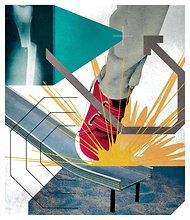
Well: At Playground, Child Plus Lap Can Equal Danger - NYTimes.com

At Playground, Child Plus Lap Can Equal Danger - NYTimes.com


First the article and then Lenore from Freerange kids provides her own unique take.


Excerpts below -the full article can be read from the link above

"Last spring, Katie Dickman of Dunkirk, Md., was at the playground with her 18-month-old toddler, Hannah, when the little girl asked to ride down a twisting slide. Ms. Dickman accompanied her daughter, carefully keeping the child on her lap as they coasted to the bottom.

But without warning, Hannah’s sneaker caught on the side of the slide. Although Ms. Dickman grabbed the leg and unstuck her daughter’s foot, by the time they reached the ground, the girl was whimpering and could not walk. A doctor’s visit later revealed a fractured tibia.....“My wife was just trying to keep Hannah extra safe and make sure she didn’t fall,” said Hannah’s father, Jed Dickman. “She felt very guilty about it.” As the Dickmans soon learned, such injuries are surprisingly common.

....This may be one of those counterintuitive cases when a child is safer by himself. If a foot gets caught while the child is sliding alone, he can just stop moving or twist around until it comes free. But when a child is sitting in an adult lap, the force of the adult’s weight behind him ends up breaking his leg.......Dr. Gaffney said he has treated three playground fractures in the last month for children sliding with a grandparent, a parent and a baby sitter....“As soon as the weather gets warm, this starts to happen,” he said. “It’s so common, but parents say: ‘How did I not know about this? I thought it was doing something good for my child by having them sit on my lap.’ ”

Andy Dworkin, a former journalist who is now a medical student in Portland, Ore., said his son Felix, then 18 months, was playing with a toddler friend at an elementary school where they were drawn to a blue slide. Felix rode down first, on the lap of his mother, but his rubber-soled shoe caught on the slide and he started to scream when he got off the slide.

Another mother, at the top of the slide with her own 17-month-old, quickly slid down with her son to try to help. But soon that little boy was crying as well. At the emergency room, both boys were found to have fractures, and they were fitted with orange and blue casts.

Both boys had full recoveries. Felix, now 3 ½, doesn’t remember the accident, but will now go down small slides only and remains cautious around large twisting slides, said Mr. Dworkin.

...To prevent the injury, the best solution is to allow a child to slide by himself, with supervision and instructions on how to play safely. Young children can be placed on the slide at the halfway point with a parent standing next to the slide. At the very least, parents should remove a child’s shoes before riding down the slide with the child on their laps, and make sure the child’s legs don’t touch the sides or sliding surface.

“I’m not saying we need to make the entire world out of rubber and insulate kids,” he said. “But this is something that is so totally predictable and preventable. That’s why I want to get the word out this one could go away.”
...................................................................................................................................................................
Wow, Who Knew? Kids Should Go Down Slides ON THEIR OWN! « FreeRangeKids
Hi Readers — and thank you for sending this story, “A Surprising Risk for Toddlers on Playground Slides,” that was in yesterday’s New York Times. And what exactly IS the surprising risk?


Parents! Extremely loving, extremely cautious parents who, rather than letting their kids navigate the slide on their own, put them on their lap and let gravity do its thing. The problem is: The thing gravity is doing is breaking their childrens’ legs.


Yes, “helping” the kids actually makes the slide experience less safe. Kids are getting their legs stuck and twisted and even broken, because (sez the story) “If a foot gets caught while the child is sliding alone, he can just stop moving or twist around until it comes free. But when a child is sitting in an adult lap, the force of the adult’s weight behind him ends up breaking his leg.”


Now, I am of at least two, possibly even three-point-five minds about this story. First off, of course, I am a little smug about the news that helicoptering doesn’t help kids. The fact that kids have been going down slides alone since Danny slid down his Dinosaur should have been evidence enough that modest inclines and moppets are a good mix. But we live in a culture that loves to demand ever more involvement on the part of parents, so a lot of folks got the idea that GOOD moms and dads are the ones who put down the Starbucks and go, “Wheeeee!” with perhaps more enthusiasm than they feel. Now they are off the hook.


ON THE OTHER HAND (we are now onto Mind #2), this article also makes it seem as if the parent/kid playground combo is the slippery slope to hell, and that slides are even MORE dangerous than anybody had ever imagined. And considering we have already imagined them as SO dangerous that regulations require them to be no taller than the average mound of laundry (or is that just at my house?), this is another blow to playground fun.


And here’s Mind #3: The fact that this issue merited an entire article in the hard copy of the New York Times — space that is disappearing faster than Happy Meal fries – is just another example of our obsession with every little thing that has to do with parenting. As if every hour of time with them is fraught with the potential for developmental leaps or horrifying danger. When really what we’re talking about is an afternoon at the playground.


And now for the .5: One point the article made is that, “The damage is not merely physical. ‘The parents are always crushed that they broke their kid’s leg and are baffled as to why nobody ever told them this could happen,’ Dr. Holt said. ‘Sometimes one parent is angry at the other parent because that parent caused the child’s fracture. It has some real consequences to families.’”


In a nutshell (and I do mean nut) here are my final thoughts:


1 – Parents are BAFFLED that NOBODY EVER TOLD THEM every single thing that could possibly go wrong in any situation? That’s one reason why we are so litigious: We expect every activity to be perfect every time, and if it’s not, we are so angry we want to blame someone (else). Not fate. Someone.


2 – While I can totally see being mad at the parent who broke my kid’s leg, I can also see moving on. Getting over it. Realizing it could have been ME. Lasting consequences seems a bit dramatic for an injury that, the article says, the children recover from in 4 to 6 weeks, without “lasting complications.” (Except, of course, for the divorce.)


3 – And, in defense of the article and the author, whose work I like, maybe the piece actually did perform a public service. Hoopla aside, now you know: Let your kid go solo down the slide.


I think I’m done. Feel free to take up where I left off. – L.

Researchers find time in wild boosts creativity, insight and problem solving - KU News

Researchers find time in wild boosts creativity, insight and problem solving - KU News

Excerpts below -the full article can be read from the link above  

"There’s new evidence that our minds thrive away from it all....Research conducted at the University of Kansas concludes that people from all walks of life show startling cognitive improvement — for instance, a 50 percent boost in creativity — after living for a few days steeped in nature.

Ruth Ann Atchley, whose research is featured in this month’s Backpacker magazine, said the “soft fascination” of the natural world appears to refresh the human mind, offering refuge from the cacophony of modern life.

“We’ve got information coming at us from social media, electronics and cell phones,” said Atchley, associate professor and chair of psychology at KU. “We constantly shift attention from one source to another, getting all of this information that simulates alarms, warnings and emergencies. Those threats are bad for us. They sap our resources to do the fun thinking and cognition humans are capable of — things like creativity, or being kind and generous, along with our ability to feel good and be in a positive mood.”

The researcher said that nature could stimulate the human mind without the often-menacing distractions of workaday life in the 21st-century.

“Nature is a place where our mind can rest, relax and let down those threat responses,” said Atchley. “Therefore, we have resources left over — to be creative, to be imaginative, to problem solve — that allow us to be better, happier people who engage in a more productive way with others.”

.....“There’s growing advantage over time to being in nature,” said Ruth Ann Atchley. “We think that it peaks after about three days of really getting away, turning off the cell phone, not hauling the iPad and not looking for internet coverage. It’s when you have an extended period of time surrounded by that softly fascinating environment that you start seeing all kinds of positive effects in how your mind works.”